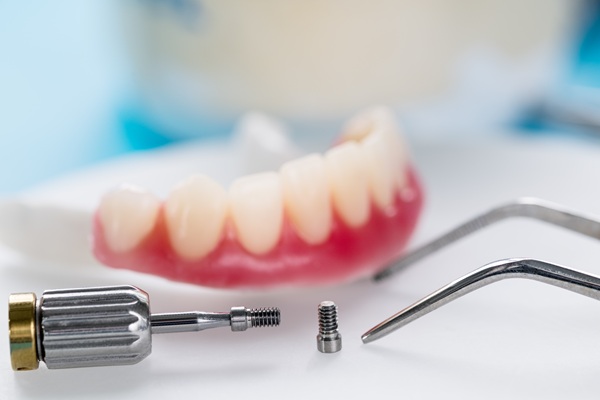
Dental implant restorations have transformed dentistry by offering a versatile and reliable solution for replacing missing teeth. This approach to smile restoration seamlessly combines durability and natural aesthetics, restoring oral function and appearance. Because implant restorations can support different types of dental prosthetics, they address a variety of needs while preserving oral health. Understanding the different types of implant restorations highlights their versatility and benefits for long-term oral care.
What is implant restoration?
Implant restoration refers to the process of placing a prosthetic tooth or teeth onto a dental implant, a titanium post that a general dentist or periodontist surgically inserts into the jawbone. The implant is an artificial tooth root that creates a stable foundation for the rest of the smile restoration (e.g., a dental crown, bridge, or permanent denture). This process not only replaces missing teeth but also restores chewing ability, speech clarity, and the smile's overall appearance.
Types of dental implant restorations
Implant restorations mimic natural teeth in function and appearance. They are custom-made to fit each patient's unique needs and can replace a single tooth, multiple teeth, or an entire arch. Thus, there is more than one type. A general dentist or periodontist will recommend one of the following types of implant restorations based on the number of teeth they must replace, the condition of the surrounding teeth, and the patient's oral health.
Single-tooth implant restoration
As the name suggests, a single-tooth implant restoration replaces one missing tooth. This type of restoration consists of three parts: the implant, the abutment, and the crown. The dental provider surgically inserts the implant into the jawbone, with which it fuses over time. The abutment is the piece that connects the implant to the visible part of the restoration (in this case, the crown).
Single-tooth implant restorations are an effective choice for patients with a single missing tooth because they do not rely on adjacent teeth for support. Unlike traditional dental bridges, which require grinding down healthy teeth, single-tooth implants preserve the integrity of the surrounding teeth. They also help maintain bone density in the jaw by stimulating the bone through regular chewing and biting forces.
Implant-supported dental bridges
A general dentist or periodontist may recommend implant-supported dental bridges when multiple teeth in a row are missing. Instead of relying on natural teeth for support, this bridge type is anchored to dental implants. This option provides a more stable and durable solution to tooth loss than traditional bridges.
The dental provider strategically places implants in the jawbone for an implant-supported bridge to act as an anchor. The number of implants needed depends on the length of the bridge and the patient's oral anatomy. Once the implants have fused with the bone, the provider will attach the bridge to the implants via abutments.
Implant-supported dentures
Implant-supported dentures are a solution for patients missing all or most of their teeth in one or both arches. Unlike traditional dentures, which rest on the gums, implant-supported dentures are anchored to dental implants. This design provides greater stability, preventing the dentures from slipping or shifting when patients eat or speak.
There are two main types of implant-supported dentures: bar-retained and ball-retained. Bar-retained dentures use a thin metal bar attached to the implants, while ball-retained dentures use ball-shaped attachments that fit into sockets on the dentures. Both options offer a secure fit and improved functionality compared to traditional dentures.
All-on-4® implant restoration
The All-on-4 technique is a popular choice for patients requiring full-arch restoration. This method uses only four strategically placed implants to support an entire arch of teeth. The dental provider positions the implants at specific angles to maximize support and stability, even in patients with reduced bone density.
All-on-4 restorations offer several advantages, including a shorter treatment time and the ability to receive a full set of teeth on the same day as implant placement. This approach eliminates the need for bone grafting in many cases. Further, the prosthetic arch attached to the implants is custom-designed to match the patient's natural teeth in appearance and function.
Get more information about implant restorations
Implant restorations are not only functional but also designed to enhance the appearance of the smile. From single crowns to full-arch solutions, each restoration is crafted with attention to detail, ensuring a natural look and feel. If you are interested in restoring your smile with implants, contact our Culver City team at Culver City Dental for more information.
Request an appointment here: https://www.culvercitydental.com or call Culver City Dental at (310) 272-5405 for an appointment in our Culver City office.
Check out what others are saying about our dental services on Yelp: Dental Implant in Culver City, CA.
Recent Posts
Dental implants are a permanent, functional solution for patients with tooth loss in one or both dental arches. Both partial and full arch dental implants have become more accessible, customizable, and successful for a wide range of patients. However, they have different uses and candidacy requirements. Understanding the differences between these options helps clarify which…
Dental implants provide a durable and natural-looking solution for missing teeth, but they do not work on their own. An implant crown serves as the final step in this process, completing the restoration and restoring smile function, appearance, and confidence. They mimic the appearance and strength of natural teeth to integrate with the rest of…
Do you need a dental implant? Read on to learn more about this type of dental restoration. Removable partial dentures and a fixed dental bridge not supported by implants are not considered permanent restorations. However, a dental implant restoration is considered permanent, as it essentially uses the same structure as a natural tooth.The benefits of…
Dental implants are one of the most common ways to replace missing teeth in general dentistry nowadays. These are screws or rods (typically made out of titanium) that can serve as artificial teeth roots. Oral restorations like crowns are fitted to implants to replace missing teeth. Implants are constructed to last a lifetime, but the…